
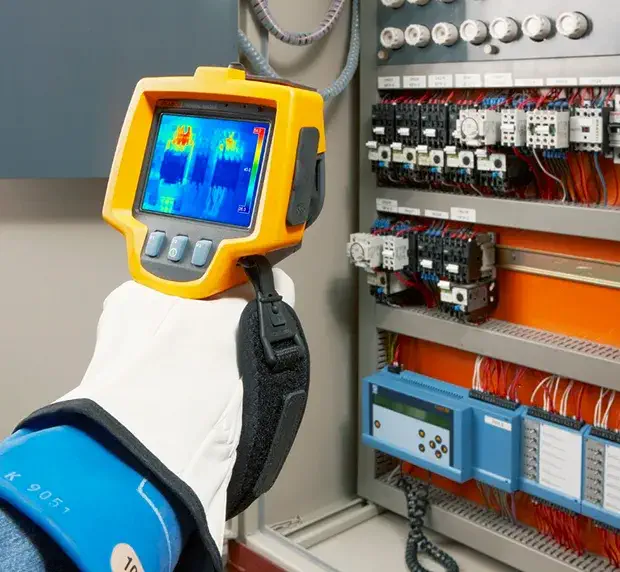
Infrared Thermography Testing is a non-invasive diagnostic technique used to detect abnormal heat patterns in electrical and mechanical systems. It plays a critical role in preventing equipment failure, electrical fires, and unplanned downtime across marine, offshore, and industrial installations.
This method uses advanced thermal imaging to identify temperature variations in both low-voltage and high-voltage systems without interrupting operations, ensuring safe and continuous monitoring.
Codes and standards of Thermographic Survey are,

NFPA 70B 2023 edition
All electrical equipment must undergo an annual infrared inspection, according to with more frequent inspections required for equipment that needs immediate repair.
NETA
Offers recommendations for Delta T (temperature differential) criterion. A Delta T of more than 15°C (27°F) between comparable components under load, for instance, denotes a serious problem that needs to be addressed right away.
ISO 18434-1 and -2
International standards for thermography data gathering and picture interpretation for machine system diagnostics and condition monitoring.
ISO 18436-7
Thermographers must meet the qualifications and certification standards require at least Level 1 certification
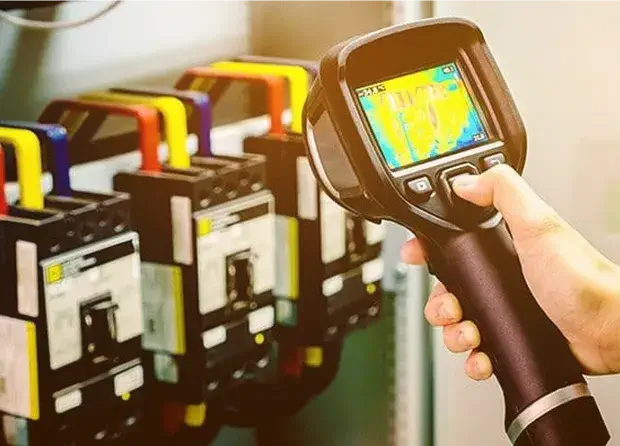
Electrical thermal imaging services in UAE
Infrared thermography surveys inspect low and high voltage electrical installations. It determines temperature variations in industrial three-phase circuits. Technicians can identify performance abnormalities by examining thermal gradients. This advanced non-invasive technique detects heat outputs using thermal scanners, converting infrared radiation into visible light. All objects above absolute zero emit infrared energy, which is the basis of thermal imaging.
Transformers
Control panels
Switch gear
Electrical cabinets
Capacity bank
Electrical Panels
MDBs/SMDBs/DBs
Bus bars
Thermal imaging is a crucial component of industrial preventative maintenance plans. By enabling the detection of anomalous heat patterns, such as those caused by overloads or impending equipment breakdowns, thermal imaging can significantly improve operational efficiency and safety. Infrared thermography can be used to identify and address minor problems before they become disastrous. Numerous electrical problems that, if ignored, could lead to equipment failure or a more serious electrical hazard can be detected by thermal patterns of electrical equipment’s survey.
Frequently Asked Questions?